
India is one of the best-performing countries in the world with a large area of wetlands. India has achieved that milestone after rigorous efforts and initiatives.
India is the third country in the world after the UK and Mexico, and ranks first in Asia with the highest number of the Ramsar sites.
These progressive efforts reflect India’s commitment towards protection, conservation and building a sustainable environment for all.
What are Wetlands
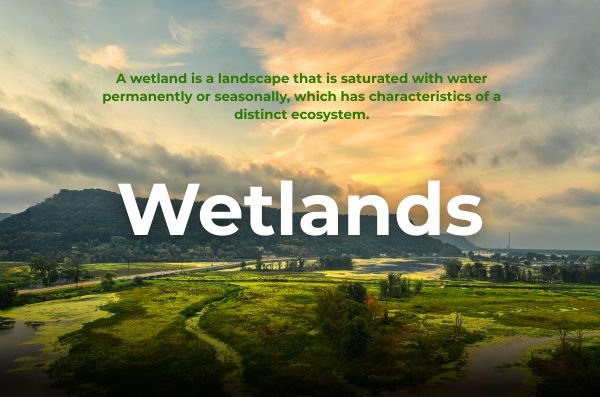
A wetland is a landscape that is saturated with water permanently or seasonally, which has characteristics of a distinct ecosystem.
Wetlands are often called the “Kidneys of the Earth.” And wetlands can be Lakes, littoral zones, floodplains, marshy and swampy areas, bogs, fens and mangroves.
Definition according to the Ramsar Convention: Wetlands are areas of marsh, fen, peatland or water, whether natural or artificial, permanent or temporary, with water that is static or flowing, fresh, brackish or salt, including areas of marine water the depth of which at low tide does not exceed six metres.
At present, there are 100 Ramsar sites located in the country. India recently added its 100th Ramsar site with the inclusion of the Jai Prakash Narayan Bird Sanctuary (Surha Tal) in Uttar Pradesh.
Classification of Wetlands
Wetlands are primarily classified into three categories based on their geographic location, water source and their nature, whether they are natural or manmade.
- Inland Wetlands
This type of wetland includes lakes, ponds, waterlogged areas, oxbow lakes, swampy or marshy areas, and seasonal collected water.
- Coastal or Marine Wetlands
This type of wetland includes estuaries, creeks, lagoons, backwaters, coral reefs, bays, mangroves, tidal flats, and salt marsh.
- Man-Made / Artificial Wetlands
This type of wetland includes aquaculture ponds, reservoirs or water storage sites, and agricultural wetlands.
| Inland | Coastal / Marine | Man Made / Artificial |
|---|---|---|
| Lakes & Ponds | Estuaries & Creeks | Aquaculture Ponds |
| Swampy & Marshy Areas | Lagoons & Bays | Reservoirs or Water Storage Sites |
| Waterlogged Areas | Mangroves & Tidal Flats | Agricultural Wetlands |
| Oxbow Lakes | Backwaters | |
| Seasonal Collected Water | Coral Reefs & Salt Marshes |
Functions or Importance of Wetlands
- They play a significant role in flood mitigation as they act as a natural barrier while absorbing excessive water, which protects the region from heavy floods.
- They serve as a biodiversity hotspot and ecological zones that provide habitat for bird species, aquatic life, flora and fauna.
- Wetlands play a crucial role in nutrient cycling by trapping nutrients like nitrogen and phosphorus as they filter sediments and nutrients from the surface and groundwater.
- They play a vital role in the stabilisation of local climate and weather patterns by regulating temperature.
- Wetlands help in groundwater recharge by holding a tremendous amount of water and reducing the runoff, especially in urban areas.
- They play a major role in water purification through the recycling process. As a result, it provides drinking water, fish, fodder and fuelwood.
- They maintain the flow of streams naturally by absorbing water and slowing down the rate of water release. This natural mechanism keeps streams flowing even during droughts and prevents them from drying up.
- Wetlands often act as a shoreline buffer for the region that protects it from erosion and degradation.
- They can be turned into tourist spots and cultural heritage sites through recreation. That helps in environmental conservation and protection.
Factors Responsible for the Depletion of Wetlands
- Conversion and development of lands for agriculture
- Removal of sand from the beds destroys the water bodies
- Turning sites into aquaculture sites
- Mass-scale habitat destruction and deforestation
- The exponentially growing pollution and domestic waste are damaging the entire ecosystem
- The agricultural runoff and industrial waste are being directly released into the water bodies without any treatment.
- Climate change, changing weather patterns, and extreme weather conditions are rapidly increasing the negative impacts.
Mitigation Strategies
- The conservation programs and management initiatives should be provided for the protection of natural and artificial regeneration.
- Timely surveys and demarcations must be provided for the safety and protection of the resources.
- There shall be effective efforts and frameworks for wildlife conservation, weed control and afforestation.
- There is a need to focus on Eutrophication abatement using traditional, sophisticated and modern approaches.
- There shall be strict authorities and administrative bodies that can solely work on the removal of encroachment and punish the offenders at the local levels, to stop exploitation and invasion.
- There must be emphasis on awareness generation campaigns to protect the environment using people participation, NGOs, voluntary groups and eminent celebrities or public figures.
Initiatives to Protect Wetlands
The Ramsar convention was signed on 2nd Feb, 1971 by the countries in Ramsar city, Iran and came into force on 21 Dec, 1975. It primarily focuses on the preservation of the ecological character of wetlands.
The Montreux Record is maintained under the Ramsar Convention, which acts as an early warning system and environmental emergency list for the protection of wetlands of global importance.
India officially became a part of the Ramsar Sites in 1982 to conserve and protect the wetlands of India.
The National Wetland Conservation Program was introduced in 1985-86 with mainly four objectives. And these objectives were:
- Policy guidelines for conservation and management.
- To undertake intensive conservation measures in priority wetlands.
- Monitor the implementation of the program.
- Prepare an inventory of Indian wetlands.
In 2012-13, the program was integrated into the National Plan for Conservation of Aquatic Eco-systems (NPCA).
India introduced Wetlands (Conservation and Management) Rules, 2017, to govern the protection, use and management of Wetlands in India.
Additionally, initiatives such as Save Wetlands Campaigns (Mission Sahbhagita), Wetland Mitras (Friends of Wetlands), Wetland Health Cards, have been introduced to strengthen the efforts for protection and wise use of wetlands.
Also Read More: