
Introduction
On April 16, 2026, the Union Government had introduced three important bills in the Lok Sabha. These bills were included the 131st Constitutional Amendment Bill, 2026, the Delimitation Bill, 2026, and the Union Territories Laws (Amendment) Bill, 2026.
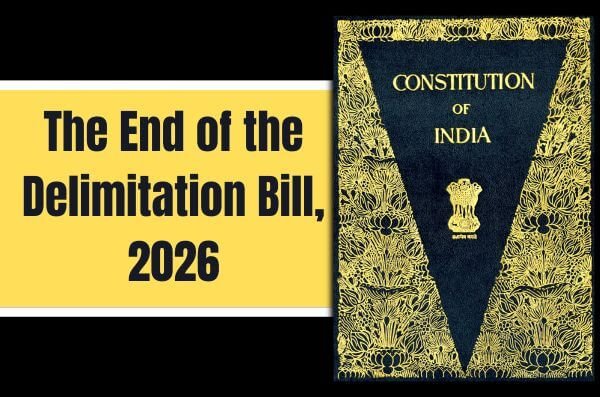
The 131st Constitutional Amendment Bill, 2026 was the main bill and other two bills were the subordinate or companion bills.
They were primarily introduced to make two major changes, first, the redrawing of electoral constituencies and second, the implementation of 33% reservation for women.
But the opposition parties voted against the 131st Constitutional Amendment Bill, 2026 and ultimately led to defeat of this bill due to a lack of support for the required two-thirds majority to pass in the Lok Sabha.
The opposition parties said the union government is making major changes in India’s federal structure and democracy. This is a new threat to India’s integrity and sovereignty, which erodes the true core values of Indian democracy
The opposition parties also clarified that they support women’s reservation, but don’t support the other changes that limit the equal representation of Indians.
The leader of the opposition also said that the implementation of women’s reservation is just an excuse to hide the main agenda of the ruling government.
What is Delimitation?
Delimitation is a process of redrawing electoral boundaries for the Lok Sabha and State Legislative Assembly constituencies to ensure equal representation of the population. It is done by the Delimitation Commission under specific constitutional provisions, and every state gets the number of seats on the basis of its population.
Is that the Women’s Reservation Bill or Not?
The present 131st Constitutional Amendment Bill, 2026, was introduced to implement one-third (33%) reservation for women in the legislature, targeting the 2029 elections.
It was brought to implement women’s reservation in the Lok Sabha and State Assemblies under the Nari Shakti Vandan Adhiniyam or 106th Constitutional Amendment Act, 2023. This act was already passed in 2023 and came into force on 16 April 2026, but has yet to be implemented.
The Delimitation Bill was interlinked with the women’s reservation. It was seeking the Amendment of Article 334A, according to which the reservation is to be implemented after a new census is completed and delimitation is exercised.
Therefore, the bill could not be passed in the Lok Sabha as the opposition called out that the bill is reshaping the political map of India, fracturing the democratic values of India.
The key Features of The Bills
131st Constitutional Amendment Bill, 2026
- It was aiming to increase the Lok Sabha seats from 543 to 850 seats by making changes in Article 81 of the Constitution.
- It was also providing that out of 850 seats; the 815 seats were to be allocated for the States and 35 seats were to be given to the Union Territories.
The Delimitation Bill, 2026
- It was seeking a fresh redrawing of the electoral constituencies based on 2011 Census Data.
- It had provisions of replacing the Delimitation Act of 2002 and empowering the Central Government to form a new Delimitation Commission.
The Union Territories Laws (Amendment) Bill, 2026
- This was aiming to extend the changes and implement women’s reservation in the assemblies of Delhi, Pudducherry, and Jammu and Kashmir.
What Concerns were Associated with the Bill?
Unfair Political Representation
The expansion of Lok Sabha seats from 543 to 850 seats was not only adding the seats but also redistributed the powers between the states. It was discriminatory in nature as it was divisive because it was shrinking the representation of the southern states like Tamil Nadu, Andhra Pradesh, Telangana, Kerala, and Odisha, on the other hand, increasing the representation of northern states like Uttar Pradesh, Bihar and Rajasthan.
It could have increased the dominance of the Hindi heartland states and reduced the southern representation, which is already at an alarming low level.
Outdated Census Data Issue
The Delimitation Bill, 2026 mentioned that it will be using 2011 Census data to redraw the electoral constituencies. The earlier Census, 2011 data can’t be taken as base to allocate and redistribute the seats because the data is outdated and doesn’t reflect the present outlook of the country. Therefore it was highly being criticised by the opposition parties and leaders including Leader of Opposition and Tamil Nadu CM M. K. Stalin.
Erosion of India’s Federal Structure
It was damaging India’s federal structure and democratic values by redrawing the political maps of India. This redistribution was shifting significant legislative powers to high-population northern states while reducing the representation of the southern states. As a result, ruling governments could have used this to manipulate the electoral constituencies deliberately to gain an unfair advantage in the elections.
Alienation Despite Growth and High Contribution
The contribution of the southern states to India’s GDP(Gross Domestic Product) and tax revenues is disproportionately high compared to the northern states. The reduction of political presentations could have alienated southern states from active political participation. The most concerning part is that the delimitation is already a boiling issue for the southern states, as these states see it as a threat to their political voices.
That’s why the southern states are opposing new bills and changes, calling it colonisation by the northern states. These new changes are dividing the country into north and south.
Conclusion
The proposed 131st Constitutional Amendment Bill, 2026 and its integration with Nari Shakti Vandan Adhiniyam also known as 106th Constitutional Amendment Act, 2023 have become landmark verdict in the Indian legislative history. It has not only affected political landscape of India but also delayed the inclusive growth and representation of women.
Therefore, there is an urgent need to prioritize women empowerment through their active participation in the democracy of India. However, the Delimitation must be separated and treated differently from women’s issues without sacrificing core values of India’s federalism and democratic institutions.