
Ebola Outbreak 2026
The World Health Organization (WHO) has declared a global health emergency due to the outbreak of Ebola virus cases in the Democratic Republic of Congo (DRC).
Moreover, the WHO also confirmed that the virus has spread across the border into Uganda and soon it can spread in South Sudan.
According to recent reports, the Ebola virus has killed over 80 people, and more than 246 suspected cases have been reported so far.
This outbreak of Ebola has raised major concerns for the health of people because the virus is one of the deadliest infectious diseases known on the planet. It can severely impact the affected region and other parts of the world.
This new outbreak of the virus involves the Bundibugyo strain of Ebola, which is one of the most dangerous strains because there is no particular vaccine or specific treatment available for this strain presently.
The Democratic Republic of Congo (DRC) warned that the strain can increase the fatality rate up to 50 percent.
The World Health Organization said the actual number of infections could be much higher than the reported cases. It has also issued a warning that the virus can spread significantly in the region.
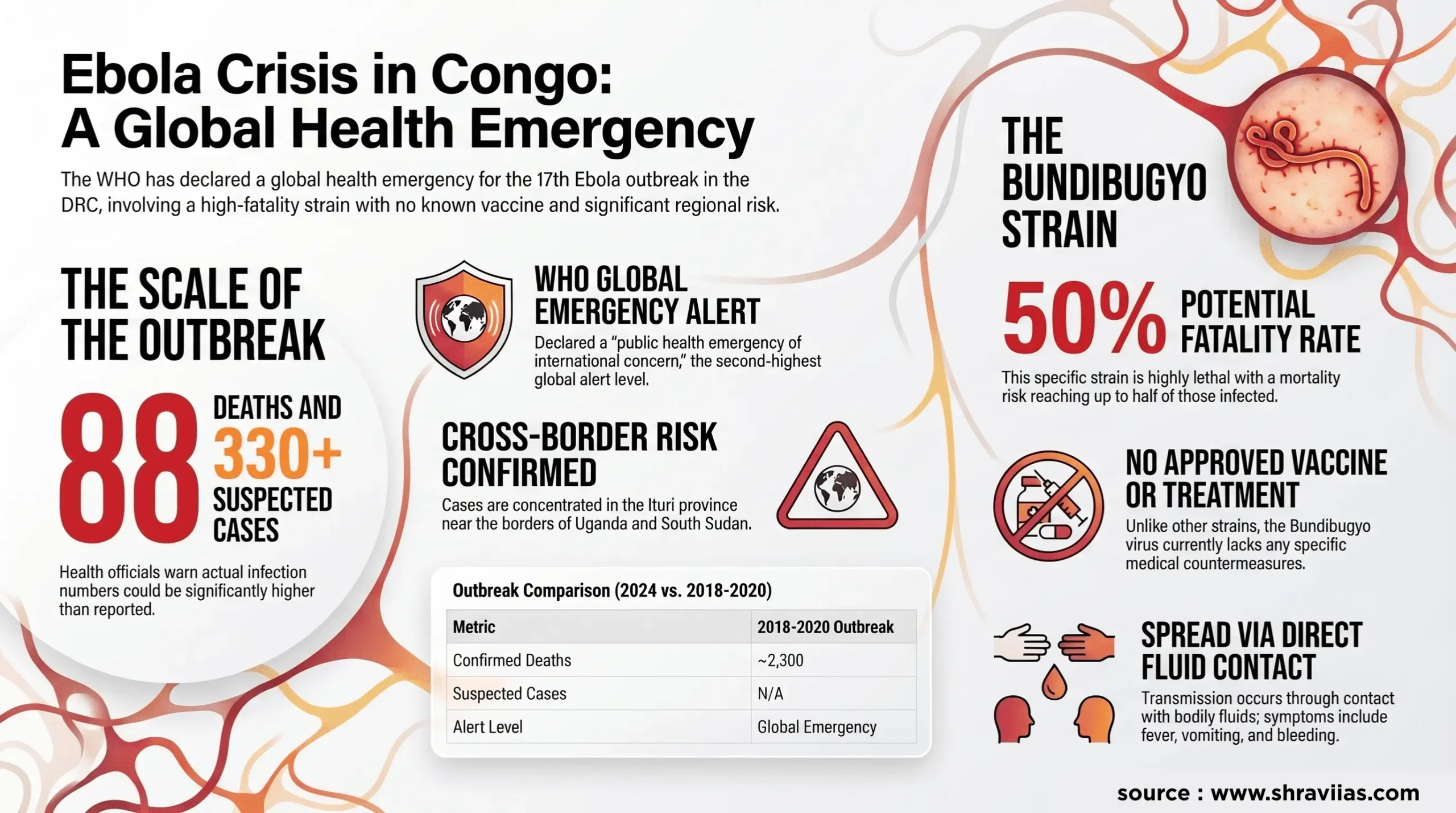
The country has faced these types of outbreak conditions multiple times in the past. During 2018 and 2020, the country witnessed one of the deadliest outbreaks of the Ebola virus, and nearly 2,300 people died during this period.
What is Ebola Virus?
The Ebola Virus Disease (EVD) is a severe, fatal infectious disease found in humans, caused by direct contact with the blood or bodily fluids of infected wild animals and spread between people through direct contact with infected bodily fluids.
Origin and Transmission of Ebola Virus
- It is caused by a group of viruses known as the Orthoebolavirus genus of the Filoviridae family.
- It is a zoonotic and extremely contagious disease that causes haemorrhagic fevers through bodily fluids.
Classification of Strain or Species of Ebola Virus
There are six major species or strains of the Ebola virus identified till now. But three major species of Ebola, including Zaire Ebola Virus, Sudan Ebola Virus, and Bundibugyo Ebola Virus, are responsible for major outbreaks with a fatality rate of around 50 percent.
Ebola Virus History and Discovery
- The Ebola virus was first identified in June, 1976 in southern Sudan, and it was the Sudan strain of Ebola Virus.
- Later, the Zaire strain of Ebola Virus was discovered in August, 1976 in the Democratic Republic of Congo in the same year.
- Furthermore, the Bundibugyo Strain of the Ebola Virus was discovered in 2007 in the western part of Uganda.
How Does the Ebola Virus Spread?
The Ebola virus can be found in wild animals such as fruit bats, monkeys, forest antelopes, chimpanzees, and gorillas. The virus spreads through direct contact with infected people’s bodily fluids.
What are the Signs and Symptoms of the Ebola Virus?
- The incubation period of the Ebola disease ranges between 2 to 21 days.
- Early Symptoms: fever, fatigue, muscle pain, headache, sore throat and malaise.
- Progressive stage symptoms: fever, diarrhea, vomiting, and bleeding.
- Final Stage: impaired kidney and liver functions and death.