
The Middle East crisis erupted after the United States and Israel conducted a large-scale coordinated attack on Iran. These strikes were launched on 28th February, 2026.
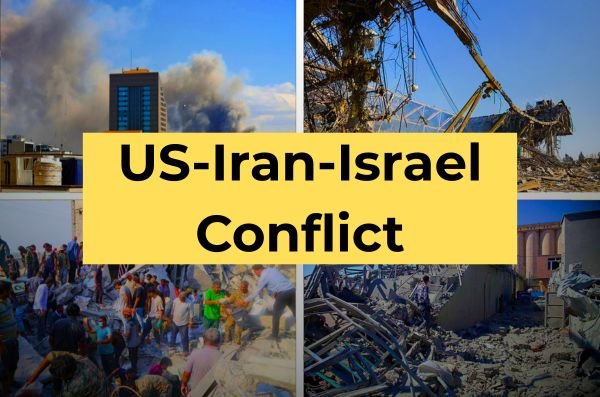
Under this attack, the US and Israel targeted Iran’s important nuclear sites, ballistic missile facilities and military and defence infrastructure located across the country.
As a response to the attack, Iran retaliated by targeting Israel directly and attacking US bases located in the Gulf region. Iran has struck US bases located mainly in the UAE, Bahrain, Qatar, Kuwait, Saudi Arabia, Iraq, and Jordan.
In addition to that, Iran also blocked the Strait of Hormuz for the American ally countries but kept it open for the friendly nations like China.
After these chain of events the West Asia region turn into a war zone. The escalation of conflict in the Middle East has spread in other parts of the world including India.
After the beginning of the crisis, India is going through a massive change. It includes energy supply crisis, share market collapse, weakening of currency, Liquified Petroleum Gas (LPG) shortage and other.
Let’s understand these impacts in the detail.
Disruption of Oil Supply
Iran has officially announced a closure of the Strait of Hormuz after the escalation of the conflict in the region.
After blocking this chokepoint, the global economy is undergoing massive change because this disruption has affected the global energy sector including India.
This blockade by Iran has disrupted crude oil supply from the region. As a result, oil prices have shot up in the global market and crossed the mark of $100 US dollars per barrel, making it one of the historic highs.
It has started increasing India’s import bill already and soon oil price surge will create market volatility in the domestic market.
India somehow managed to get the oil supply by diversifying the crude oil import from the Middle East to Russia. But now the Russia has narrowed the discount to provide crude oil. It means, now India will have to pay more to buy Russian oil.
However, bulk industrial diesel prices have seen a gain of nearly 25%, which has impacted sectors like logistics, mining and manufacturing. Moreover, after the increase in Aviation Turbine Fuel (ATF) cost, international flight fares have increased by about 15% by the airlines.
The growing tensions in the Middle East has started creating chaos in the other parts of the world including India. The energy uncertainty and instability have created a fear of inflation, which might cause damage to the Indian markets.
The LPG Cylinder Crisis
India is facing a severe LPG crisis due to the ongoing Middle East conflict. A sudden shortage of LPG cylinders is hurting Indian households, restaurants, and other small businesses.
If we observe consumption, we will find India primarily consumes about 31.3 million tons of LPG every year and nearly 87% of it is used in household kitchens.
Talking about the ground reality, people are queuing up in front of gas agencies for cylinders and struggling to get access. The shortage is mainly impacting the middle-class and lower-middle households.
The story doesn’t end here; hotels are trimming their menus, people are shutting their small tea stalls and hotels. Moreover, a black market of cylinders has emerged, where LPG cylinders are being sold for 1500 to 5000 rupees.
To deal with the situation, the government has invoked the Essential Commodities Act and ordered oil refineries to increase LPG production.
Oil marketing companies such as Indian Oil and Bharat Petroleum which together produce around 40% of India’s LPG requirement, have been instructed to prioritize domestic consumers.
But the ground reality is that, people are still struggling to get LPG cylinders. Amidst the crisis, India obtained permission from Iran to let the stranded Indian LPG vessels pass through the Strait of Hormuz, but only few of them could pass through the region.
India is still engaged in dialogue with Iran for the remaining vessels to pass. But let’s see how long it takes to complete the deal.
Weakening of the Indian Rupee
Since the eruption of this conflict Indian currency has faced a hard hit on its value. Because the Indian rupee has recorded a historic fall against the US dollar.
It has crossed 93 rupees per US dollar, burdening India’s forex reserves and making energy supply more expensive for India.
The fascinating thing is, it is just the beginning of the problems, experts say if the escalations continue to grow, it is going to create a huge economic collapse and disruption for the world. And if we monitor the situation closely, it can already be seen on the ground.
After the weakening of Indian rupee, India’s spending of foreign currency, specifically the dollar have increased. It means now India must spend more US dollars for the same amount of oil. As a result, it would increase the current account deficit.
India’s Share Market Collapse
Since the eruption of the Middle East conflict, the global markets, including the Indian market, are experiencing a bloodbath.
The Indian share markets have lost approximately 48.29 lakh crore rupees in the last four weeks since the conflict started.
The Sensex and Nifty have plunged by over 1500 points, wiping out a huge amount of money from the market.
That has resulted in huge turmoil in the market, making investors panic and forcing them to withdraw their money.
It has negatively impacted industries like banking and finance, aviation, logistics, and IT services. On the other side, some industries such as Defence and Renewable Energy saw a positive jump.
India’s Agriculture under Pressure
The crisis has affected India’s fertilizer supply chain because India is heavily dependent on the fertilizer supply from the Middle East countries. It has resulted in a shortage of fertilizers and a rise in their prices in the local markets, burdening Indian farmers.
India primarily imports fertilizers such as urea, diammonium phosphate, and potash in large quantities. Nearly half of these supplies come from this region, which highlights the significance of the region for Indian agriculture. Saudi Arabia and Oman play a crucial role in the supply chain of these fertilizers in India.
The fertilizer demand rises during the peak season, especially between May and July, because it is the sowing season for crops like rice, corn and cotton.
The shortages and delays are significantly impacting the Indian agriculture sector.
Moreover, the rising input costs, stagnant crop prices, and growing financial stress are affecting Indian farmers. India is a country where agriculture is the backbone of the economy, and the Middle East conflict can also shape India’s agriculture in many ways.
Conclusion
The growing tensions between the US-Iran-Israel have disrupted the entire West Asia and turned the region into a destabilised and vulnerable hostile territory. And if the situation continues further, it might create challenges for the entire world, including India.