
On 26th November 1949, India adopted its constitution. During that time our Indian Constitution had Preamble, 395 articles and eight schedules.
Presently, there are twelve schedules in the Indian Constitution. We have added more schedules in our constitution according to the requirements.
In this article, Let’s learn about the Schedules of the Indian Constitution in detail.
Evolution of Schedules
Schedules are the tables which contain additional details not mentioned in the constitution.
The Government of India Act, 1935 was the first act which mentioned the schedules and there were ten schedules in that act.
Originally, the constitution of India had eight schedules and later four more schedules were added in our constitution.
The Ninth Schedule, which is Land reforms and abolition of the zamindari system, was added through the first constitutional amendment act, 1951.
The Tenth Schedule, which is ‘Anti-Defection Law’ was added through the fifty Second Constitutional Amendment Act, 1985.
The Eleventh Schedule, which is ‘Panchayats’ was added through the Seventy-Third Constitutional Amendment Act, 1992.
And finally, the Twelfth Schedule, which is ‘Municipalities’ was added through the Seventy-Fourth Constitutional Amendment Act, 1992.
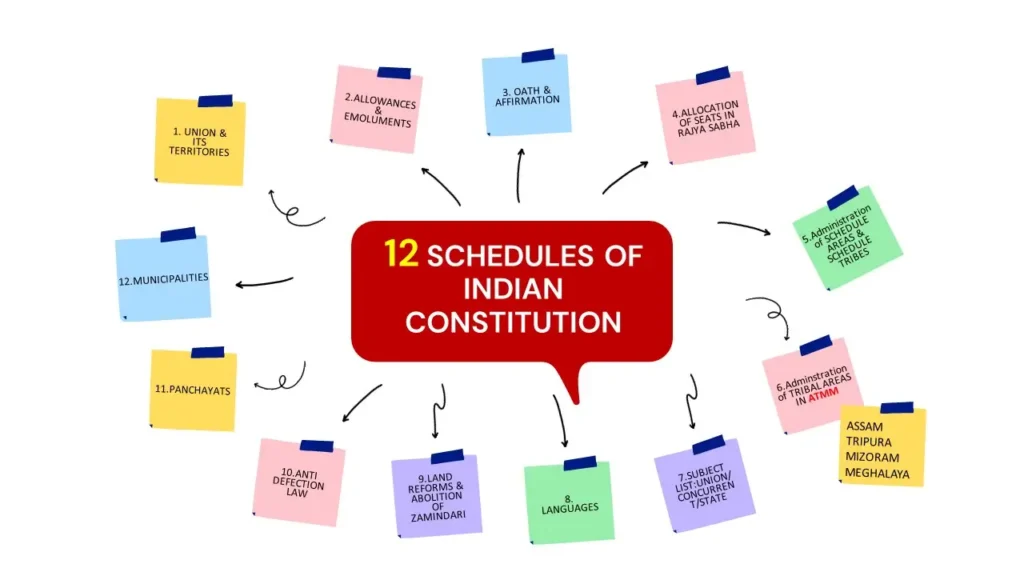
Schedules in the Indian Constitution
First Schedule
The first schedule of the constitution deals with the name and territorial extent of the states and the union territories of India. It covers Article 1 and Article 4 of the constitution.
Second Schedule
The Second Schedule of the constitution contains the provisions related to allowances, privileges, emoluments and so on of The President of India,
The governors of the states, The speaker and the deputy speaker of the Lok sabha, The chairman and the deputy chairman of the Rajya Sabha, The speaker and the deputy speaker of The Legislative Assembly in the states, The Chairman and the Deputy Chairman of the legislative council in the states, The judges of supreme court, The judges of the high courts, The comptroller and Auditor General of India.
It covers the articles such as Article 59, Article 65, Article 75, Article 97, Article 125, Article 148, Article 158, Article 164, Article 186 and Article 221.
Third Schedule
The Third schedule of the constitution deals with Forms of Oath or Affirmation for The Union Ministers, The Candidates for Election to the Parliament, The members of Parliament, The judges of the Supreme Court, The Comptroller and Auditor-General of India, The State Ministers, The Candidates for Election to the State Legislature, The members of the State Legislature, The Judges of the High Courts.
This schedule covers articles such as Article 75, Article 84, Article 99, Article 124, Article 148, Article 164, Article 173, Article 188, and Article 219.
Fourth Schedule
The Fourth Schedule of the constitution deals with allocation of seats in the Rajya Sabha to the States and the union territories. It covers Article 4 and Article 80 of the Constitution.
The Allocation of the seats are done on the basis of the population hence they vary from state to state. For Instance: UP has the highest number of seats in the Rajya Sabha on the other side Tripura has lowest number of seats in the Rajya Sabha.
Moreover, out of eight union territories only three UTs including Delhi, Puducherry and Jammu & Kashmir have representation in Rajya Sabha.
Fifth Schedule
The fifth schedule of the constitution contains the provisions related to the administration and control of scheduled areas and scheduled tribes. It covers Article 244 of the Indian constitution.
Sixth Schedule
The sixth schedule of the constitution contains provisions relating to the administration of tribal areas in the states of Assam, Meghalaya, Tripura and Mizoram. It covers Article 244 and Article 275 of the Constitution.
Seventh Schedule
The seventh schedule of the constitution talks about the divisions of powers between the Union and the States. The subjects have been categorized in three lists and that is Union list, State list and the Concurrent list. It covers Article 246 of the Constitution.
The subjects under Union list are dealt by Union or Centre, the subjects under the State list dealt by States and the subjects under Concurrent list dealt by centre and state together.
Presently, the Union list contains 98 subjects, the State list contains 59 Subjects and the Concurrent list contains 52 subjects.
Eighth Schedule
The eighth schedule of the Constitution contains the provisions related to the languages. There are 22 languages present in that schedule. Originally, there were 14 languages present in this schedule. It covers Article 344 and Article 351 of the Constitution.
Sindhi was added by the 21st Amendment Act, 1967, Konkani, Manipuri and Nepali were added by the 71st Amendment Act, 1992 and Bodo, Dongri, Maithili and Santhali were added by the 92nd Amendment Act, 2003.
If we observe the demography of India, we will find that there are so many languages spoken in India. But the constitution of India recognizes only 22 languages on the basis of certain criteria.
Ninth Schedule
The ninth schedule of the constitution deals with the ‘Land Reforms’ and the ‘Abolition of Zamindari system.’ It covers Article 31-B of the Constitution.
This schedule was added by the 1st Amendment Act, 1951 to protect the laws included in it from judicial review on the ground of violation of fundamental rights.
However, the Supreme Court ruled that the laws included in this schedule after 24th April, 1973 are open to judicial review.
Tenth Schedule
The tenth schedule of the constitution deals with the provisions related to ‘Anti-Defection Law.’ It means the provisions relating to disqualification of the members of Parliament and State Legislatures on the grounds of defection.
It covers Article 102 and Article 191 of the Constitution. This schedule was added by the 52nd Amendment Act, 1985.
Eleventh Schedule
The eleventh schedule of the constitution deals with the ‘Panchayats.’ It specifies the powers, authority and responsibilities of Panchayats. It covers Article 243-G of the Constitution.
There are 29 matters covered under this schedule. This schedule was added by the 73rd Amendment Act, 1992.
Twelfth Schedule
The twelfth schedule of the constitution deals with the ‘Municipalities.’ It specifies the powers, authority and responsibilities of Municipalities. It covers Article 243-W of the Constitution.
There are 18 matters covered under this schedule. This was added by the 74th Amendment Act,1992.