
A writ is a formal written order issued by a judicial or administrative authority to enforce legal rights or resolve disputes.

They are legal remedies for protecting the rights of individuals, especially against actions or inactions by public authorities.
For Example: Dr. Gitanjali, the wife of Sonam Wangchuk filed a Habeas Corpus writ petition under Article 32 of the constitution against detention of Sonam Wangchuk who was arrested under NSA(National Security Act).
The Constitution of India empowers both the Supreme Court and High Courts to issue writs.
The Supreme Court under Article 32 and the High Courts under Article 226 of the Constitution can issue the writs.
Parliament can empower any court to issue the writs. It means subordinate courts also can be empowered to issue the writs. However, no such provision has been made so far.
Before 1950, only High courts of Calcutta, Bombay and Mudras had the powers to issue writs. Now the article 226 of the constitution empowered all the high courts to issue writs.
We have adopted this concept from English law where the writs originated as a formal written command by the Monarch and were popularly known as ‘Prerogative writs’.
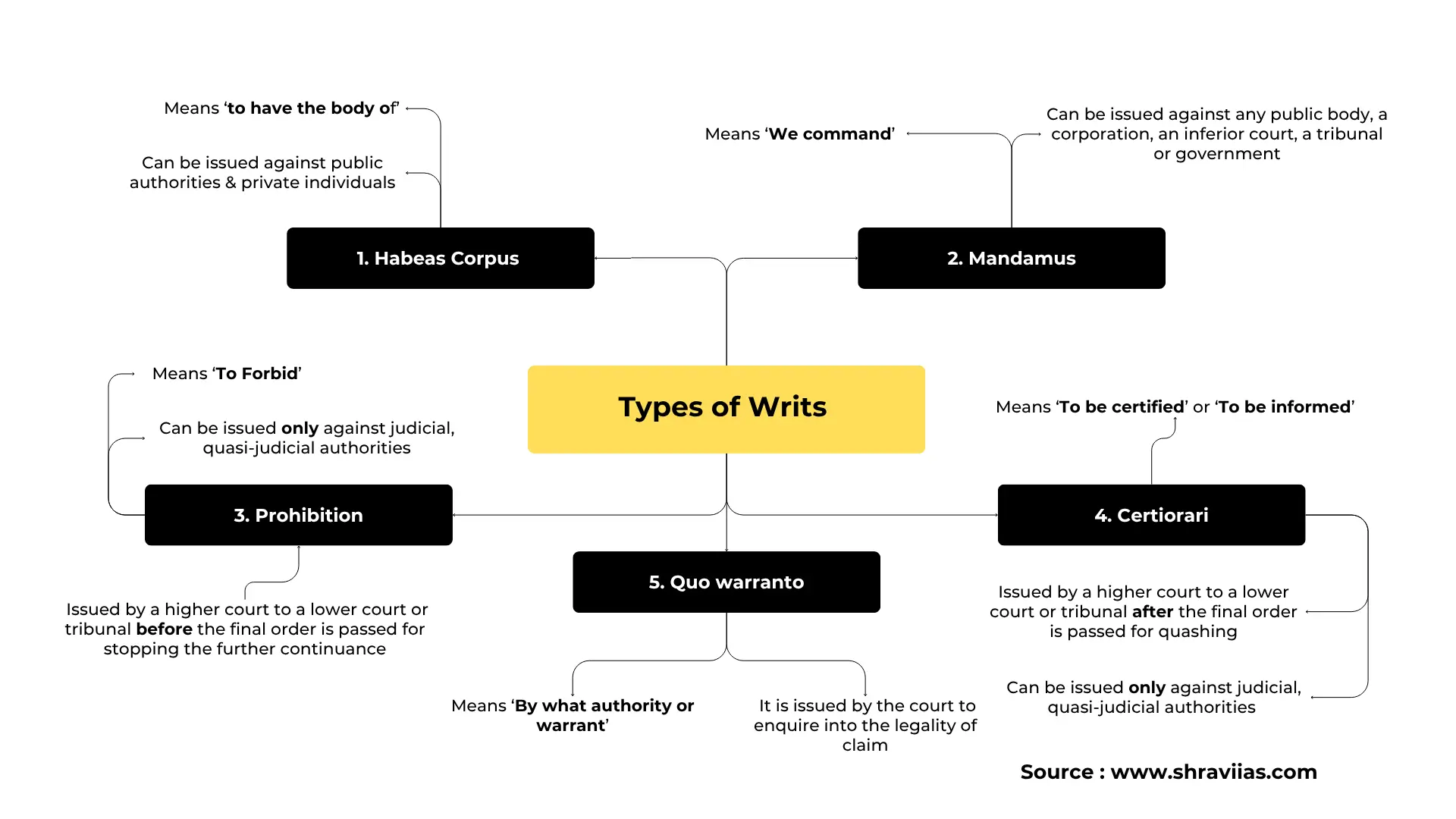
Types of Writs
- Habeas Corpus : Means ‘to have the body of’. Can be issued against public authorities & private individuals
- Mandamus : Means ‘We command’. Can be issued against any public body, a corporation, an inferior court, a tribunal or government
- Prohibition : Means ‘To Forbid’. Issued by a higher court to a lower court or tribunal before the final order is passed for stopping the further continuance. Can be issued only against judicial, quasi-judicial authorities.
- Certiorari : Means ‘To be certified’ or ‘To be informed’. Issued by a higher court to a lower court or tribunal after the final order is passed for quashing. Can be issued only against judicial, quasi-judicial authorities.
- Quo warranto : Means ‘By what authority or warrant’. It is issued by the court to enquire into the legality of claim.
Significance of Writs
- They play crucial role in governance as they serve as a powerful tool for upholding constitutionality and rule of law.
- They help courts in judicial review by allowing judiciary to examine the actions of the legislative and executive branches.
- They protect the rights of individuals by holding public authorities accountable.
- They ensure lawful and transparent public administration.
Difference B/W Supreme Court and High Court writs
Let’s understand the difference between Supreme Court and High Court writs jurisdiction.
| Supreme Court (Article 32) | High Court (Article 226) |
|---|---|
| Only for enforcement of Fundamental rights | For enforcement of Fundamental and other legal rights |
| Must hear the Petition under Article 32 | Under Article 226, It’s a discretionary in nature and hence high court may refuse |
| Against a person or government throughout the territory of India | Against a person or government or authority located within its territorial jurisdiction with some possible extensions |
| Can be suspended under Article 359 during a national emergency | Cannot be suspended even during a national emergency |