
The National Green Tribunal (NGT) has given approval to the Infrastructure Development Project in Great Nicobar after providing required safeguards.
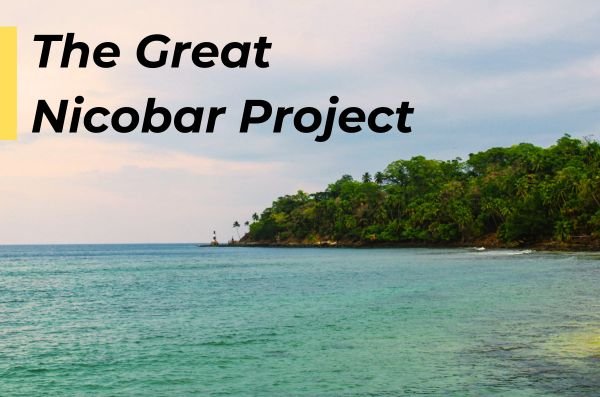
What is the Great Nicobar Project?
- The Great Nicobar Infrastructure Development Project is a Rs 81,000 Crore mega project.
- It is one of India’s largest greenfield infrastructure projects in a remote island territory. It mainly focuses on the transformation of the southern tip of Great Nicobar.
- It aimed at transforming the region into a trans-shipment hub, a strategic maritime outpost, a civil and military logistic centre, and a new urban settlement.
Location of Great Nicobar Island
- The Great Nicobar Island is the southernmost Island of India. It is located in the Andaman and Nicobar archipelago.
- It is very close to the Malacca Strait with a distance of about 40 nautical miles. The Malacca Strait is one of the busiest and geo-strategically significant sea routes in the world. Because it is a source of a large percentage of global trade, and connects Europe and Asia.
- Most importantly, it’s a significant oil route for most Asian countries. That’s why this infrastructure development project is a geopolitically important step in the region.
Why is the Great Nicobar Project a Game-Changer?
- India will be able to use it as an International Container Trans-shipment Port (ICTP). As a result now India will be able to dock large vessels carrying thousands of heavy containers. Because many Indian ports are shallow ports, which can not be used to dock ‘‘mother vessels’’ directly.
- At present India’s approximately 75% trans-shipment cargo is handled outside including Colombo (Sri Lanka), Singapore, and Port Klang (Malaysia). Under this project, India will not be dependent on others to manage and control big size cargo ships.
- This will strengthen India’s capacity and the Great Nicobar region can be used as a one of the major global hubs. For instance: South East Asian countries like Thailand, Malaysia, Myanmar, and Indonesia etc. can get the benefits from it.
- The project includes the development of Greenfield International Airport, which will be used to manage civilian traffic and military aircraft operations. It will strengthen India’s logistics and emergency response, resulting in a boost to connectivity especially in critically important regions.
- It also proposes building of Integrated Township in the region by creating residential complexes, schools and hospitals, administrative buildings, commercial and non-commercial infrastructure. It will create a sustainable environment for the population.
- It aims to focus the development of power and utility infrastructure to make the region self-sustainable as a port of long term goal. Under the project, 450 MVA gas-based and solar hybrid power plant, water treatment systems, digital infrastructure and road connectivity will be created.
- The Development of Great Nicobar will help India to gain control over key sea routes in the region. Moreover, India’s proximity to this choke point and improved maritime surveillance will enhance the strategic leverage in the Indo-Pacific region.
- A strong Indian presence at Great Nicobar will strengthen India’s “Act East Policy” and regional deterrence capability, resulting in counter balancing aggressive maritime expansion of China under “String or Pearls” strategy in the Indian Ocean.
- The project will give a boost to the Indian economy by reducing the extra cost and time in transportation. It will improve the logistics supply of goods by providing efficient port connectivity and global shipping. This will boost India’s manufacturing sector ultimately leading to exponential growth of trade and commerce.
However, this ambitious infrastructure project can severely impact the environment and create challenges in the region. In addition to that, It might also raise other social concerns in the region. Let’s understand them in detail.
What’s Wrong with the Great Nicobar Project?
- The Andaman and Nicobar Islands are eco-sensitive zones and ecologically fragile areas. It makes the region environmentally sensitive as it is a biodiversity hotspot, home to mangroves and coral reefs, and nesting ground for leatherback turtles. The project poses a serious threat to the ecological balance and environmental diversity of the region.
- The Great Nicobar Island is home to the indigenous communities such as Shompen tribe and Nicobarese community. This project can create concerns of displacement and cultural erosion. Moreover, exposure to the external population will give rise to the spread of diseases, leading to create existential threat for the local population.
Conclusion
The National Green Tribunal (NGT) has given approval to this Infrastructure Development Project in Great Nicobar after the clearance from the Ministry of Environment, Forest and Climate Change (MoEFCC). The project has moved forward after years of delays and strict scrutiny. It means now the project can be continued under full compliance with environmental conditions.