
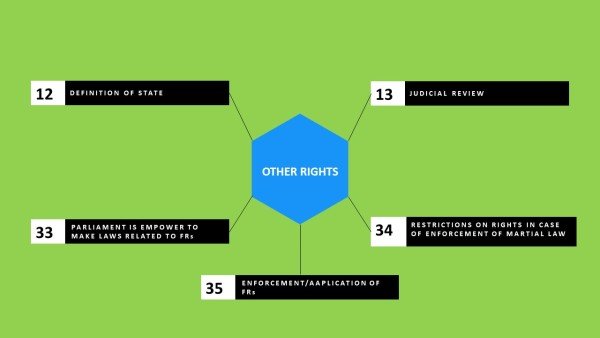
The Fundamental Rights are enshrined in Part III of the Indian Constitution. And Article 12 to Article 35 deal with Fundamental Rights.
We have derived inspiration for FR from the United States of America (USA). Part III of the constitution described as the ‘Magna Carta of India’.
Magna Carta was the Charter of Rights issued by King John of England in 1215 and it was the first foundational document of Fundamental Rights of citizens.

Fundamental Rights mindmap-1
The Fundamental Rights are guaranteed by the constitution. They are justiciable in nature and promote the ideal of political democracy.
They uphold equality, dignity, larger public interest and unity of the nation.
They prevent the establishment of an authoritarian and despotic rule in the country. They aim at establishing ‘a government of laws and not of men’.
Fundamental Rights mindmap-2
Originally, the constitution of India had provided 7 fundamental rights. However, the right to property was deleted by the 44th Constitutional Amendment Act,1978 and made a legal right under Article 300-A in Part XII of the constitution.
At present, there are 6 Fundamental Rights in the Indian Constitution.
The List of Fundamental Rights
Right to Equality : Article 14 to Article 18
- Article 14 : Equality before law and equal protection of laws
- Article 15 : Prohibition of discrimination on the grounds of religion, race, caste, sex or place of birth
- Article 16 : Equality of opportunity in public employment
- Article 17 : Abolition of untouchability
- Article 18 : Abolition of titles except military & academic

Fundamental Rights mindmap-3
Right to Freedom : Article 19 to Article 22
- Article 19 : Protection of 6 rights : i) Speech and expression ii) Assembly iii) Association iv) Movement v) Residence and vi) Profession
- Article 20 : Protection of conviction for offences
- Article 21 : Protection of life & personal liberty
- Article 21-A : Right to elementary education
- Article 22 : Protection against arrest & detention in certain cases
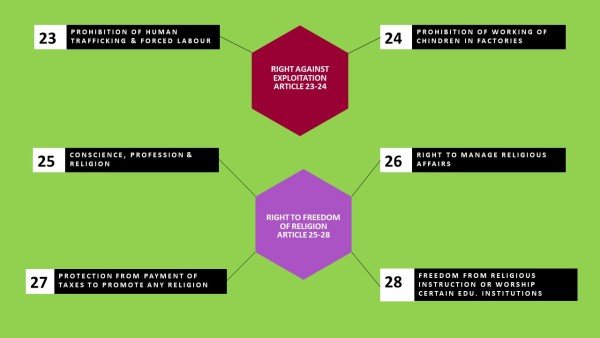
Right Against Exploitation : Article 23 to Article 24
- Article 23 : Prohibition of human trafficking & forced labour
- Article 24 : Prohibition of employment of children in factories
Fundamental Rights mindmap-4
Right to freedom of Religion : Article 25 to Article 28
- Article 25 : Freedom of conscience & profession, practice & propagation of religion
- Article 26 : Freedom to manage religious affairs
- Article 27 : Freedom from payment of taxes for promotion of any religion
- Article 28 : Freedom from religious instruction or worship in certain educational institutions
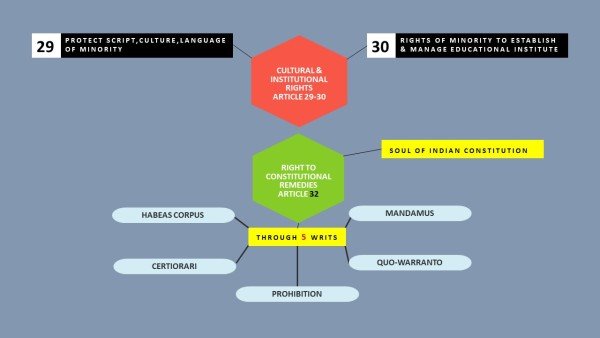
Cultural and Educational Rights : Article 29 to Article 30
- Article 29 : Protection of language, script & culture of minorities
- Article 30 : Right of minorities to establish & administer educational institutions
Fundamental Rights mindmap-5
Right to Constitutional Remedies : Article 32
- Dr. B.R. Ambedkar described Article 32 of the Indian constitution as the ‘Heart and Soul’ of the Indian Constitution.
- Right to constitutional remedies means any citizen can move to the supreme court for the enforcement of fundamental rights including the writs (habeas corpus, mandamus, prohibition, certiorari and quo-warranto).
Fundamental Rights Mind map pdf Download
Also Download and read more :