
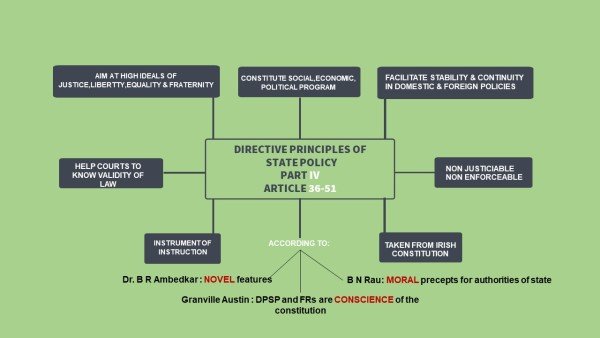
The Directive Principles of State Policy (DPSP) are given in Part IV of the Indian Constitution. Article 36 to Article 51 of the constitution deals with the Directive Principles.
DPSP mindmap-1
The Directive Principles have been taken from the Irish constitution.
According to :
- Dr. B. R. Ambedkar : ‘Novel features’
- B. N. Rau : ‘Moral precepts for authorities of state’
- Granville Austin : DPSP and FRs are ‘Conscience of the constitution’
Significant Features of Directive Principles
- The DPSP denote the ideals that State should follow.
- The DPSP are the instrument of instructions.
- They constitute social, economic and political program and seek to establish economic and social democracy.
- They are non justiciable as well as non enforceable in nature.
- They help courts to examine and determine the constitutional validity of law.
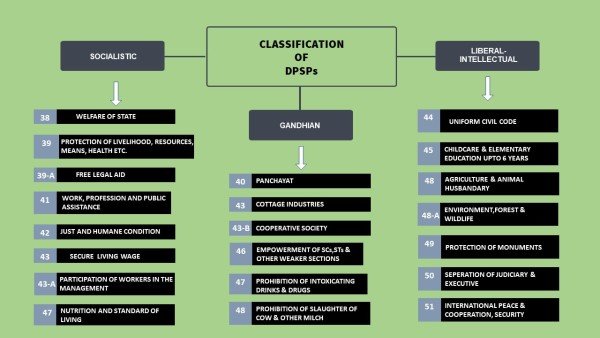
The Directive principles are classified into 3 categories namely Socialistic, Gandhian and Liberal-Intellectual on the basis of their core and direction. Let’s understand this classification in detail.
DPSP mindmap-2
The Classification of Directive Principles
Socialistic Principles
- Article 38 : Welfare of State and minimize inequalities
- Article 39 : Secure livelihood, equitable distribution of resources, Non concentration of wealth, Equal pay and Health
- Article 39-A : Free Legal Aid
- Article 41 : Work, Education & Public assistance
- Article 42 : Just and Humane conditions
- Article 43 : Secure a Living Wage
- Article 43-A : Participation of Workers in the Management
- Article 47 : Nutrition & Standard of living
Gandhian Principles
- Article 40 : Panchayat
- Article 43 : Cottage Industries
- Article 43-B : Co-operative Societies
- Article 46 : Empowerment of SCs, STs & Other weaker sections
- Article 47 : Prohibition of intoxicating drinks & drugs
- Article 48 : Prohibition of slaughter of cows, calves & other milch
Liberal-Intellectual Principles
- Article 44 : Uniform Civil Code
- Article 45 : Childcare & Education up to 6 years
- Article 48 : Agriculture & Animal Husbandry
- Article 48-A : Environment, Forests & Wildlife
- Article 49 : Protection of Monuments
- Article 50 : Separation of judiciary & executive
- Article 51 : International peace & security
DPSP mindmap-3
Important Amendments
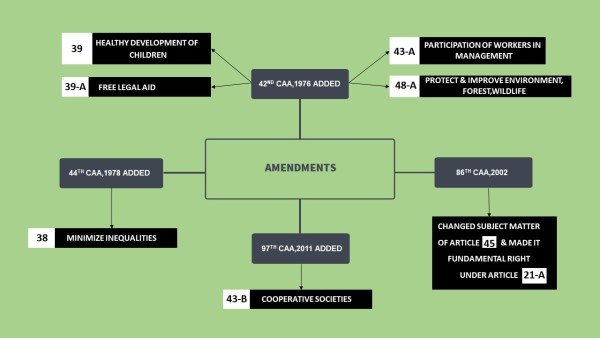
42nd Constitutional Amendment Act, 1976
This amendment added 4 new Directive Principles to original list
- Article 38 : Healthy development of children
- Article 39-A : Free Legal Aid
- Article 43-A : Participation of Workers in the Management
- Article 48-A : Protect & improve Environment, Forests & Wildlife
44th Constitutional Amendment Act, 1978
This amendment added one more Directive Principle
- Article 38 : Minimize Inequalities
86th Constitutional Amendment Act, 2002
This amendment changed the subject matter of Article 45 and made it a fundamental right under Article 21-A.
97th Constitutional Amendment Act, 2011
This amendment added new Directive Principle
- Article 43-B : Co-operative Societies
DPSP mindmap-4
Important Judicial Cases
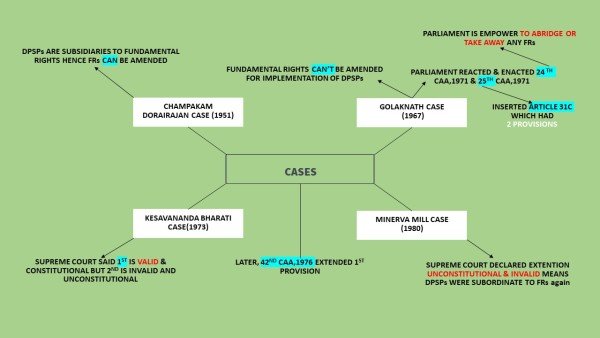
Champakam Dorairajan Case (1951)
- DPSPs are subordinate to the fundamental rights hence FRs can be amended.
Golaknath Case (1967)
- The Fundamental Rights can’t be amended for the implementation of Directive Principles
- Parliament reacted & enacted :
- 24th CAA, 1971 : Parliament is empowered to abridge or take away any Fundamental Right
- 25th CAA, 1971 : Inserted Article 31-C which had 2 provisions
Kesavananda Bharati Case (1973)
- The Supreme Court declared 1st provision of Article 31-C constitutional & valid but 2nd provision of Article 31-C is unconstitutional and invalid
- Later 42nd Constitutional Amendment Act, 1976 extended the 1st provision of Article 31-C
Minerva Mill Case (1980)
- Supreme Court declared extension unconstitutional and invalid, means Directive Principle were made subordinate to Fundamental Rights again
Therefore, the present position is that the Parliament can amend the Fundamental Rights for implementation of Directive Principles, so long as the amendment doesn’t damage or destroy the Basic Structure of the Constitution
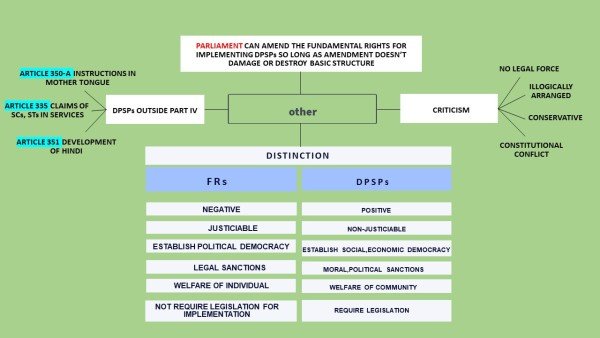
DPSP mindmap-5
DPSPs Outside Part IV
- Article 350-A (Part XVII) : Instructions in mother tongue
- Article 335 (Part XVI) : Claims of SCs & STs to services
- Article 351 (Part XVII) : Development of the Hindi
Criticism of Directive Principles
- No Legal Force
- Illogically Arranged
- Conservative
- Constitutional Conflict
Distinction Between FRs and DPSPs
| Fundamental Rights | Directive Principles |
|---|---|
| Negative | Positive |
| Justiciable | Non-justiciable |
| Political Democracy | Social & Economic Democracy |
| Legal Sanctions | Moral & Political Sanctions |
| Welfare of Individual | Welfare of Community |
| Not Require any Legislation for Implementation | Require Legislation for Implementation |
Directive Principles of State Policy (DPSP) Mind map pdf Download
Download and Read more :