
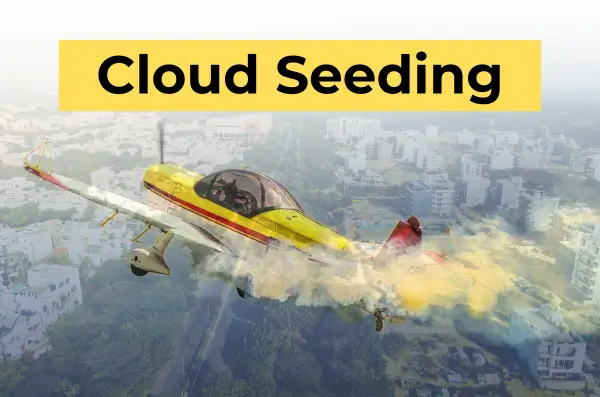
Delhi is facing a severe air quality crisis and a toxic layer of smog has settled over the city. This hazardous thick blanket has disrupted people’s lives and many of them are facing serious health conditions.
But the fact is, this is not the first time when Delhi has faced the worst air quality crisis in the city. The city faces that menace every year and it is one of the major concerns faced by the people of Delhi especially in winter.
Therefore, this year the Delhi government conducted a trial of cloud seeding to cope with the growing air pollution crisis in the city.
However, this experiment of pollution control failed and couldn’t resolve the toxic smog issue in the city. Because artificial rain did not occur in the region due to insufficient moisture in the air.
What is Cloud Seeding?
Cloud seeding is a scientific technique of weather modification used to enhance rain or precipitation. It is primarily conducted to induce artificial rainfall in the targeted regions.
How the Cloud Seeding Works?
First of all, clouds with sufficient moisture are identified then the chemical substances are released into these clouds using aircrafts or rockets.
In this cloud seeding, substances like Silver Iodide, Sodium Chloride (salt), or Dry Ice (solid CO₂) are injected into the clouds to stimulate droplet or ice crystal formation, which lead to precipitation in the form of rain or ice.
These agents serve as artificial condensation or ice nuclei, leading to larger droplets or crystals formation and finally fall as rain.
Applications of Cloud Seeding
Cloud seeding can be useful in a wide range of purposes including increase of rainfall, pollution control and restoration of natural resources. This sophisticated method is being used in different parts of the world including India.
In India, states like Maharashtra, Karnataka and Tamil Nadu have used cloud seeding during droughts in the region.
Moreover, countries such as China, USA and UAE have been using cloud seeding for agricultural purposes, weather modification and even to clear sky before big events.
Types of Cloud Seeding
There are two types of cloud seeding :
- Hygroscopic Seeding : In this technique, salts are used in warm clouds to speed up water droplet formation. These salt particles help water droplets stick together and grow bigger, eventually leading to rainfall.
- Glaciogenic Seeding : In this technique, agents like Silver Iodide or Dry Ice are used in cold clouds to trigger ice formation, eventually leading to rainfall.
Static and Dynamic are the two operational modes used in the cloud seeding. They can use either hygroscopic or glaciogenic agents for seeding based on cloud type and the goal.
Advantages / Benefits of Cloud Seeding
- Cloud seeding can increase water supply in arid regions, as a result it can help to increase rainfall in drought-prone regions.
- It can be used to enhance snowfall or snowpack in mountain regions.
- Cloud Seeding can also be helpful to refill reservoirs and ground water in the water scarce regions.
- It can reduce hail damages and suppress hailstorms by promoting smaller hailstones dramatically.
- It can be used to control air pollution or pollution management by using artificial rain and cooling temperature in targeted areas.
- Cloud seeding also can be used to clear the fog at airports.
However, cloud seeding is not a guaranteed method as it is highly influenced by factors such as wind speed, moisture in clouds, and cloud type. The data from WMO (World Meteorological Organization) indicate that cloud seeding can increase precipitation by 5-15% under specific conditions.
These meteorological conditions can change the outcomes. Apart from that, it also comes with some challenges or limitations.
Challenges or Limitations of Cloud Seeding
- Cloud seeding doesn’t guarantee success, it may be uncertain as it completely relies on the presence of sufficient moisture and cloud type.
- It only provides a temporary solution, it can’t replace or substitute natural precipitation or rain.
- Artificially altering weather can disrupt the natural rain cycle or weather pattern of the region.
- Cloud seeding is an expensive method and it requires high-end specialized equipment to perform the task.
Conclusion
Cloud seeding is a marvelous scientific tool that provides reasonable powers to boost natural capacity of weather under favorable conditions, but it must be used responsibly without causing damages to the environment.