
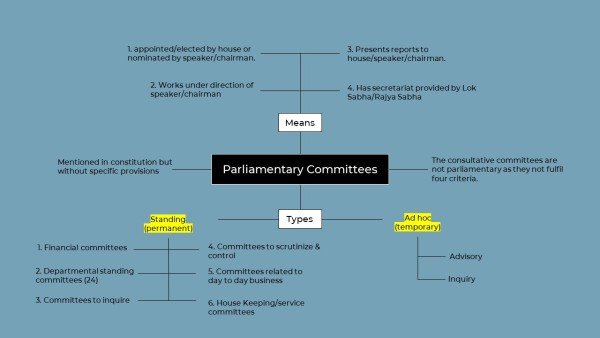
The constitution of India mentions the parliamentary committees but without making any specific provisions regarding their composition, tenure, functions etc.
Parliamentary Committees mindmap-1
A parliamentary committee means:
- Appointed/elected by house or nominated by speaker/chairman.
- Works under direction of speaker/chairman.
- Presents its report to the house/speaker/chairman.
- Has secretariat provided by Lok Sabha or Rajya Sabha.
The consultative committees are not parliamentary committees because they do not fulfill above four conditions.
The parliamentary committees are divided into two categories:
- Standing committees: Permanent
- Ad hoc committees: Temporary
Parliamentary Committees mindmap-2
Standing committees
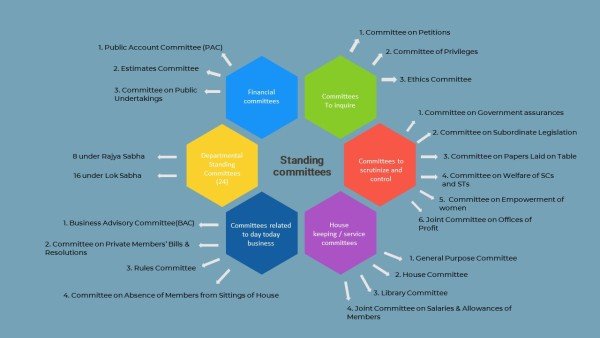
The standing committees are classified into six categories as follow:
1. Financial Committees
- Public Account Committee (PAC)
- Estimate Committee
- Committee on Public Undertakings
2. Departmental Standing Committees
- 8 committees work under the Rajya Sabha
- 16 committees work under the Lok Sabha
3. Committees to Inquire
- Committees on Petitions
- Committee of Privileges
- Ethics Committee
4. Committees to scrutinize and control
- Committee on government assurances
- Committee on subordinate legislation
- Committee on papers laid on the table
- Committee on welfare of SCs and STs
- Committee on Empowerment of Women
- Joint Committee on Offices of Profit
5. Committees related to day-to-day Business
- Business Advisory Committee (BAC)
- Committee on Private Members’ Bills and Resolutions
- Rules Committee
- Committee on Absence of Members from Sittings of the House
6. House Keeping or Service Committees
- General Purposes Committee
- House Committee
- Library Committee
- Joint Committee on Salaries and Allowances of Members.
Ad Hoc Committees
Ad hoc committees can be divided into two categories such as Inquiry Committees and Advisory Committees.
Also Download and Read more: